
דילוג לתוכןSkip to content

Research

What other sellers charge, what's starting to move in your sales, and what sells again each season.

A product is catching on and the holiday's coming. Will you know in time, or only once the shelf is empty?

What Research reads

Four signals, one desk.Three move forward. The next step is yours.

Three come from real data. The fourth doesn't exist yet.

Research

Demo data
  • What others chargeOne click, for a product scanned from a supplier linkLive today
  • What's picking upFrom your sales, every six hoursLive today
  • What comes back each seasonFor items with history loaded from the previous systemLive today
  • What trends onlineDoesn't exist in the system yetWhere it's headed

1 of 4

New product from a supplier.

What are other Israeli sellers charging for it?

Research

Demo data

Wooden jewelry box

Google Shopping in Israel · 9 sellers

₪119Lowest₪149Median₪189Highest
Median copied to price field

Live todayOne click, one product at a time

2 of 4

Another product is picking up.

The trend comes from your own sales.

Research

Demo data

Thermal bottle

Rising

Rising means the change tops 20 percent, with at least 3 units sold across both periods combined.

Live todayThe screen shows the arrow. The bars spell out why.

The data's all thereA person passes it on

Marketing

Email draft

Stays a draft until approved

Website

Top of category

Plus the home page's main banner

3 of 4

The holiday isn't here yet.

Last year's sales already show it.

Research

Demo data

Hanukkah chocolate gift box

Last year, same months

Monthly average
40
Growth this year
×1.3
Forecast per month
52
Last month's pace
21

The engine uses whichever is higher

Live todayFor items with history loaded from the previous system

Inventory

Order 90

Awaiting approval

At last month's pace alone, order 24. With the season factored in, order 90.

4 of 4

And what people are saying online?

That doesn't exist in the system yet. It's where this is going.

The fourth signal

  • What's trending on social media
  • Competitors' promotions
  • A new product people are talking about

Doesn't exist in the system yet

Where it's headed

Research brings the signal.

You make the call.

The data's all thereSee exactly what runs
  • For a product scanned from a supplier link, one button pulls that product's sellers from Google Shopping in Israel and works out the lowest, median, average and highest price. A second click copies the median into the price field. The check only runs when you click, one product at a time, and doesn't track prices over time.

    LIVEisraeli-price-compare

  • Every six hours, each stock-managed product gets a trend label (rising, stable or falling) from the last 30 days compared with the 30 before. Rising means the change tops 20 percent and at least 3 units were sold. The screen shows the label, and the engine never places an order on its own.

    LIVEreplenishment-engine-6h

  • For items with sales last year, expected demand is the average of the same three months last year, adjusted for the item's growth this year (capped between half and double), or the last 30 days' pace if that's higher. Last year's data is the previous system's history, loaded by hand, and it doesn't update on its own.

    LIVEseasonal-forecast-yoy

  • In the categories screen, you can pin a product to the top of one category without changing the order in the others. The home page's main banner is edited in a visual editor, and a campaign email is written from a single request and stays a draft until approved. All of this runs today. A person carries the trend to these tools: no screen yet suggests, on its own, pinning or promoting a product with a rising trend.

    DERIVABLEcategory-order-and-pins

Product names, prices and quantities here are demo data. The math is real: the median, the trend and the order quantity use the same rules the system runs.

End of the demo.

Here's the real screen, with the season already counted.

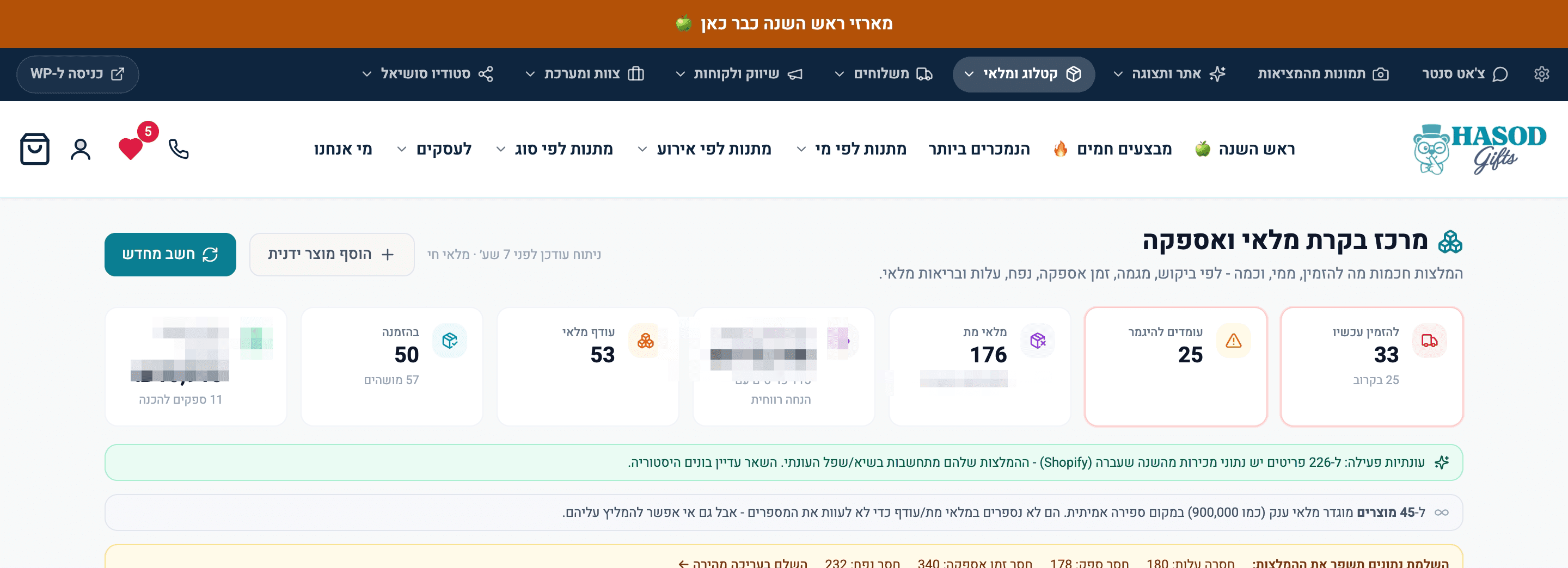
The inventory center in the business MOVA was built on. The green strip says that for items with sales last year (history loaded from the previous system), the recommendation already accounts for the seasonal peak and never drops below last month's pace. Money amounts are blurred.

176 dead-stock items, 25 about to run out, and 33 worth ordering today.A real screen from the system

176 dead-stock items, 25 about to run out, and 33 worth ordering today.

The system MOVA was built on

What the Research department does

  1. What others charge, before you set a price

    Live todayHow it works
    • For a product scanned from a supplier link, one button pulls that product's sellers from Google Shopping in Israel, with price, rating and shipping, and works out the lowest, median, average and highest price. A second click copies the median into the price field. The check only runs when you click, one product at a time, and only for products scanned from a supplier link. Products already in your catalog aren't checked, and no price gets rechecked over time.

      LIVEisraeli-price-compare

  2. What's starting to move

    Live todayHow it works
    • Every six hours, each stock-managed product gets a trend label (rising, stable or falling) from the last 30 days compared with the 30 before. Rising means the change tops 20 percent, with at least 3 units sold across both periods combined. Out-of-stock days are left out of the demand calculation, but the trend counts every day, so a product that sold out may show as falling.

      LIVEreplenishment-engine-6h

  3. What sold this season last year

    Live todayHow it works
    • For every item with sales last year, the engine takes what sold in the same three upcoming months last year, adjusts it for the item's growth this year (capped between half and double), and uses whichever is higher: that, or the last 30 days' pace. That's how a holiday item turns urgent before the rush. Last year's data is the previous system's history, loaded by hand, and it doesn't update on its own, so an item sold only on the current website doesn't get this forecast yet.

      LIVEseasonal-forecast-yoy

  4. What customers ask for, in their own words

    Live todayHow it works
    • One screen groups customers' chat questions into patterns, with real quotes and a suggested next step, like featuring a product people ask for or opening a collection. The report is built when you open the screen, and the number next to each pattern is an estimate, not a count. People decide whether a recurring request is worth a new product in the catalog.

      LIVEvoice-insights-knowledge

  5. What hasn't sold in months, by supplier too

    Live todayHow it works
    • A list of every product published on the website that hasn't sold a single unit in the last 90 or 180 days. The check includes sales from before the current website, so an older product that moved to the new system isn't counted as new. Narrow the list to one supplier to see which of their products haven't sold at all.

      LIVEdead-stock-filter

  6. New product links since the last scan

    Live todayHow it works
    • Enter a supplier's category, and the system collects every product link in it, up to 50 pages. On a repeat scan, only links not already in the queue get added, and the screen tells you how many new ones it found. On the first scan, every link counts as new, and so does a link that changed. The scan runs when you click it, and it doesn't update prices or stock for products you've already imported.

      LIVEsupplier-feed-crawler

  7. And online chatter? It doesn't exist in the system yet

    Where it's headedHow it works
    • Social media trends, competitors' promotions and new products people are talking about don't exist in the system yet. Today, nothing listens to what's posted on social networks, and nothing regularly tracks competitors' websites. That's where the department is headed.

      VISION

Who the Research department talks to

What they decide together

Each row is one department and the decision their conversation leads to. Pick a row to see the conversation.

ResearchInventory

A product's sales are climbing. The suggested reorder climbs with them.

Illustration
  1. ResearchHoney gift box: the last 30 days are up more than 20 percent on the 30 before. Trending up.
  2. InventorySales picked up, so the suggested reorder did too. It's waiting for your approval.

Reorder based on what's selling now, before the shelf runs empty.

Live todaySee exactly what runs
  • Every six hours, each stock-tracked product is marked rising, stable or falling, comparing the last 30 days with the 30 before: rising when the change tops 20 percent and at least 3 units sold. The same calculation sets the suggested reorder quantity from the sales pace, and it never places an order on its own.

    LIVEreplenishment-engine-6h

Open Inventory

The question we get about this department

So the system knows what's trending online?

Not yet, which is why this page marks it as where the product is headed. What exists today rests on what's actually measured: your sales, what sold in the same season last year for items with that history, and what other Israeli sellers charge for a product scanned from a supplier link. Every six hours, a rising sales trend gets marked on the product's row, and what you do with it is your call.

Where it's headedSee exactly what runs
  • The trend comes from the business's own sales: the last 30 days compared with the 30 before, for every stock-managed product, every six hours.

    LIVEreplenishment-engine-6h

  • Other sellers' prices come from Google Shopping in Israel, in one click, for a product scanned from a supplier link.

    LIVEisraeli-price-compare

  • Social media trends and competitors' promotions don't exist in the system yet. Today, nothing listens to what's posted on social networks, and nothing regularly tracks competitors' websites.

    VISION